Search “glass bottle manufacturer India” and you’ll get pages of results — directories, marketplace listings, company websites — almost all using the word “manufacturer” somewhere in their name or headline. The problem is, a meaningful number of them aren’t manufacturers at all. They’re traders or suppliers reselling glass produced by someone else, sometimes with a markup, sometimes with no real visibility into production quality or timelines.
This distinction sounds technical, but it has real consequences for price, lead time, customization, and quality control. Here’s how to actually tell the difference, and why it matters.
Why This Distinction Matters
A manufacturer owns or directly controls the factory producing the glass. They set production schedules, control quality at the source, and can usually offer genuine customization — because they’re the ones running the molds and furnaces.
A supplier or trader, by contrast, typically buys finished or semi-finished glass from one or more manufacturers and resells it, often across multiple brands or product lines. This isn’t inherently dishonest — plenty of legitimate businesses operate this way — but it does mean:
- They have less direct control over production timelines, since they’re dependent on the manufacturer they’re sourcing from
- Customization requests often have to pass through an extra layer, slowing things down and sometimes limiting what’s actually possible
- Pricing usually includes a markup on top of what the actual manufacturer would charge directly
- Quality consistency depends on whichever factory they happened to source that batch from, which can vary order to order
For a one-off small order, this difference might not matter much. For an ongoing supply relationship — especially one involving custom molds, branding, or large volumes — it matters a great deal.
Red Flags That a “Manufacturer” Is Actually a Reseller

A few patterns tend to show up consistently when a company calling itself a manufacturer is actually operating as a trader:
Vague or evasive answers about the factory location. A genuine manufacturer will readily tell you where their production facility is — often a specific city or industrial cluster known for glass production. Vague answers, or reluctance to share this, is a meaningful warning sign.
No willingness to arrange a factory visit or video call of the production floor. This has become an easy, low-cost way for buyers to verify legitimacy, especially for international buyers who can’t visit in person. A real manufacturer generally has nothing to hide here.
Inconsistent product range across “their” catalog. If a single supplier’s website shows wildly different glass styles, finishes, and quality levels that don’t look like they came from one production line, it’s often because they didn’t — they’re aggregating stock from multiple manufacturers.
Pricing that doesn’t move much even on larger orders. Manufacturers typically have more room to adjust pricing at scale, since they control the cost structure directly. Resellers, who are themselves paying a manufacturer’s price, often have far less flexibility.
No clarity on customization timelines. Ask specifically how long mold development takes for a custom shape or embossing. A real manufacturer will give you a concrete answer because they know their own production process. A trader will often need to “check and get back to you” — because they have to ask someone else.
Questions to Ask to Verify You’re Dealing With an Actual Manufacturer
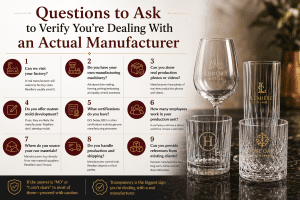
A short, direct set of questions early in the conversation usually surfaces the truth quickly:
- “Can I see your factory, either in person or via video call?” Legitimate manufacturers rarely hesitate here.
- “What’s your daily/monthly production capacity?” A specific, confident number (not a vague “we can handle any order”) is a good sign.
- “Do you have GST registration and export documentation available?” Reputable manufacturers, especially those handling export orders, will have this readily available.
- “If I need a custom mold, how long does development typically take?” Manufacturers know this number cold; resellers often don’t.
- “Can I speak to your production or quality team directly, not just sales?” Access to people actually involved in making the product is a strong signal of direct manufacturing control.
Why This Matters for Pricing, Lead Time, and Customization
Working directly with a manufacturer typically means:
- Better pricing, since you’re not paying a reseller’s margin on top of production cost
- More realistic lead times, since the people quoting you are the same people controlling the production schedule
- Genuine customization capability, since mold development, embossing, and branding decisions are made in-house rather than relayed through an intermediary
- More consistent quality, since every batch comes from the same controlled production process rather than potentially varying suppliers
None of this means every trader or supplier is a bad choice — for very small or one-time orders, the convenience of a broker-style supplier can be genuinely useful. But for any buyer planning an ongoing relationship, custom branding, or meaningful order volume, working directly with the manufacturer almost always produces a better outcome.
How to Confirm Glastic Global’s Manufacturing Credentials
We’re often asked these exact questions, and we’d rather buyers ask them upfront than find out the hard way after placing an order elsewhere. Glastic Global manufactures glass bottles, jars, tumblers, and drinkware directly out of our own production facility in Firozabad, India — the country’s established glass manufacturing hub — using both blown and pressed glass-making techniques.
That means when you work with us:
- You’re speaking directly with the people controlling production, not a relayed third party
- Customization — embossing, logos, particular artwork, mold development — happens in-house
- MOQs and lead times are quoted based on our actual production schedule, not someone else’s
- We’re able to arrange factory visibility for buyers who want to verify before committing to an order
If you’re currently evaluating suppliers for glass bottles, jars, or custom drinkware, it’s worth running this same checklist against anyone you’re considering — including us.
Get in touch with our team to discuss your requirements.