Walk into almost any well-branded bar or boutique hotel today and you’ll notice it — the glass in your hand isn’t generic. A subtle embossed logo on a whisky tumbler, a printed monogram on a water glass, a custom shape that doesn’t exist anywhere else. For HoReCa businesses (hotels, restaurants, and cafes), custom branded glassware in India has quietly become one of the easiest ways to make a guest’s experience feel deliberate, rather than off-the-shelf.
If you’re considering this for your own property or restaurant group, here’s what’s actually worth knowing before you order.
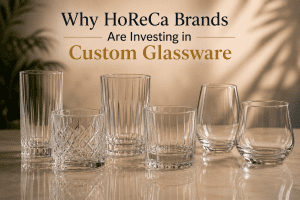
Why HoReCa Brands Are Investing in Custom Glassware
A glass is one of the few things a guest physically holds for an extended period — at the bar, at the table, in their hand while they take a photo. That makes it disproportionately valuable as a branding surface compared to, say, a napkin or a coaster, which get glanced at and set aside.
Beyond aesthetics, there are a few concrete reasons this trend has accelerated:
- Social media visibility — branded glassware shows up in guest photos and stories, functioning as quiet, recurring marketing that costs nothing per impression after the initial order
- Perceived value — a custom glass signals attention to detail, which guests subconsciously extend to their judgment of the food, drinks, and service overall
- Consistency across properties — for hotel groups or multi-location restaurant chains, custom glassware keeps the brand experience uniform regardless of which location a guest visits
- Differentiation in a crowded market — standard stock glassware looks identical across competitors; custom glassware doesn’t
Printing vs Embossing — What’s the Real Difference
These two techniques get used almost interchangeably in casual conversation, but they’re genuinely different processes with different results.
Printed glassware applies a design (logo, text, pattern) onto the surface using specialized glass-safe inks, typically through screen printing. This allows for color, fine detail, and multi-color logos — ideal if your brand identity relies on a specific color palette or intricate design.
Embossed glassware physically shapes the design into the glass itself during the molding process, creating a raised or recessed texture rather than a printed surface layer. This gives a more premium, tactile feel — and importantly, it doesn’t wear off with repeated washing the way some printed finishes can over years of heavy commercial use.
Which to choose:
- Choose printing if your logo has multiple colors or fine detail that needs to stay sharp and visible
- Choose embossing if you want a more subtle, durable, premium feel — common for upscale bars, fine dining, and luxury hotel properties
- Some brands combine both — an embossed base shape with a printed logo — for a layered effect
MOQ and Turnaround Time for Branded Glassware Orders
This is usually the first practical question any HoReCa buyer asks, and the honest answer is: it depends on the technique and the manufacturer, but here’s a general framework.
- Minimum order quantities for custom branded glassware typically scale with the customization complexity — simple printed logos can sometimes start at relatively modest order sizes, while embossed (mold-based) customization usually requires higher minimums, since it involves developing a dedicated mold.
- Lead time for printed glassware tends to be shorter, since it doesn’t require new mold development. Embossed glassware takes longer upfront due to mold creation, but once the mold exists, repeat orders are typically faster.
- Sampling — any credible manufacturer should be willing to provide a sample before a full production run. If a supplier resists this, treat it as a red flag.
If you’re a smaller, independent restaurant or boutique hotel rather than a chain, ask directly about flexible MOQs — many manufacturers, including ours, have moved toward more accessible minimums specifically because demand from independent HoReCa businesses (not just large hotel groups) has grown.
Real Considerations Beyond the Logo
A few practical factors matter more in daily commercial use than they might seem during the design phase:
Durability for commercial use. HoReCa glassware goes through far more handling and washing cycles than retail glassware. Ask your manufacturer about the glass thickness and base weight — heavier-bottomed glasses generally hold up better to daily bar use and are less prone to chipping.
Dishwasher safety. Commercial dishwashers run hotter and more frequently than home machines. Confirm your printed or embossed design is rated for commercial dishwasher cycles — some lower-quality printed finishes fade or peel under repeated high-heat washing.
Breakage rate expectations. No glassware is breakage-proof, but ask your supplier what breakage rate is typical for the glass type and shape you’re ordering, especially for high-volume bar environments. This helps with realistic reorder planning.
Packaging for transit. If you’re ordering for a property outside the manufacturer’s local region, ask about packaging — corrugated, cardboard, or carry-case options all affect how much breakage occurs in transit, which directly affects your effective cost per usable glass.
How Glastic Global Handles Custom Branded Glassware Orders

We manufacture both blown and pressed glassware out of Firozabad, India’s established glass manufacturing hub, and custom branding — logos, names, embossing, and particular artwork — is something we build into the production process rather than treat as an afterthought.
What that looks like in practice for HoReCa buyers:
- Both printing and embossing capability, so the technique is chosen based on what suits your brand, not what’s easier for us
- Flexible MOQs that scale with your order size, rather than a single rigid minimum
- A range of glass types already in production — whisky glasses, tumblers, wine glasses, and more — that can be customized rather than built from scratch, which keeps lead times shorter
- Packaging options (thermal, corrugated, cardboard, carry-case) suited to safe transit, especially relevant if you’re ordering for a property outside Firozabad
If you’re weighing custom glassware for an upcoming property launch, refresh, or seasonal menu, it’s worth getting a quote early — mold development and sampling take time, and starting that process a few weeks ahead of your target date avoids a last-minute scramble.
Get in touch with our team to discuss your custom glassware requirements.